The canopy edge, the wall flashing and the downspout at an industrial dock door all meet within a few feet, and a roof that leaks near the door usually has more than one of them to answer for. Woodlake Industrial Center is made up of seven Class A industrial buildings with more than 812,000 square feet between them in Cary, NC, near Research Triangle Park and RDU International Airport, with I-40 and I-540 among the routes serving it. Floor area tells us the buildings are large; it does not tell us how big any roof is or what it is made of. So we treat each building as its own file, walk it from the dock canopies to the field, and write down what we find before suggesting any work.
Dock areas combine the hardest working parts of a building: overhead doors that shake the wall, trucks that strike canopies, and downspouts that discharge onto aprons where water freezes or ices over in winter and puddles in summer. We check the canopy edge, the edge metal return and the sealant at the wall, then follow the downspout to grade and note any erosion or ponding at the apron. If a canopy has been struck, we look for bent brackets and lifted membrane. Water that gets behind a header runs down inside the wall and wets insulation, so we compare the stain on the interior wall with the flashing outside. Findings are photographed in a set order so a later visit can compare them. The order runs from the canopy edge to the wall to the downspout to the apron, which keeps one dock bay's record comparable with the next.
Insulation at the dock edge deserves a check as well. Boards near a repeatedly leaking canopy can stay wet for a long time, and a moisture reading near the wall tells us whether the fix needs to reach beyond the visible stain. Infrared moisture survey data can show the extent without opening a large area of the roof.
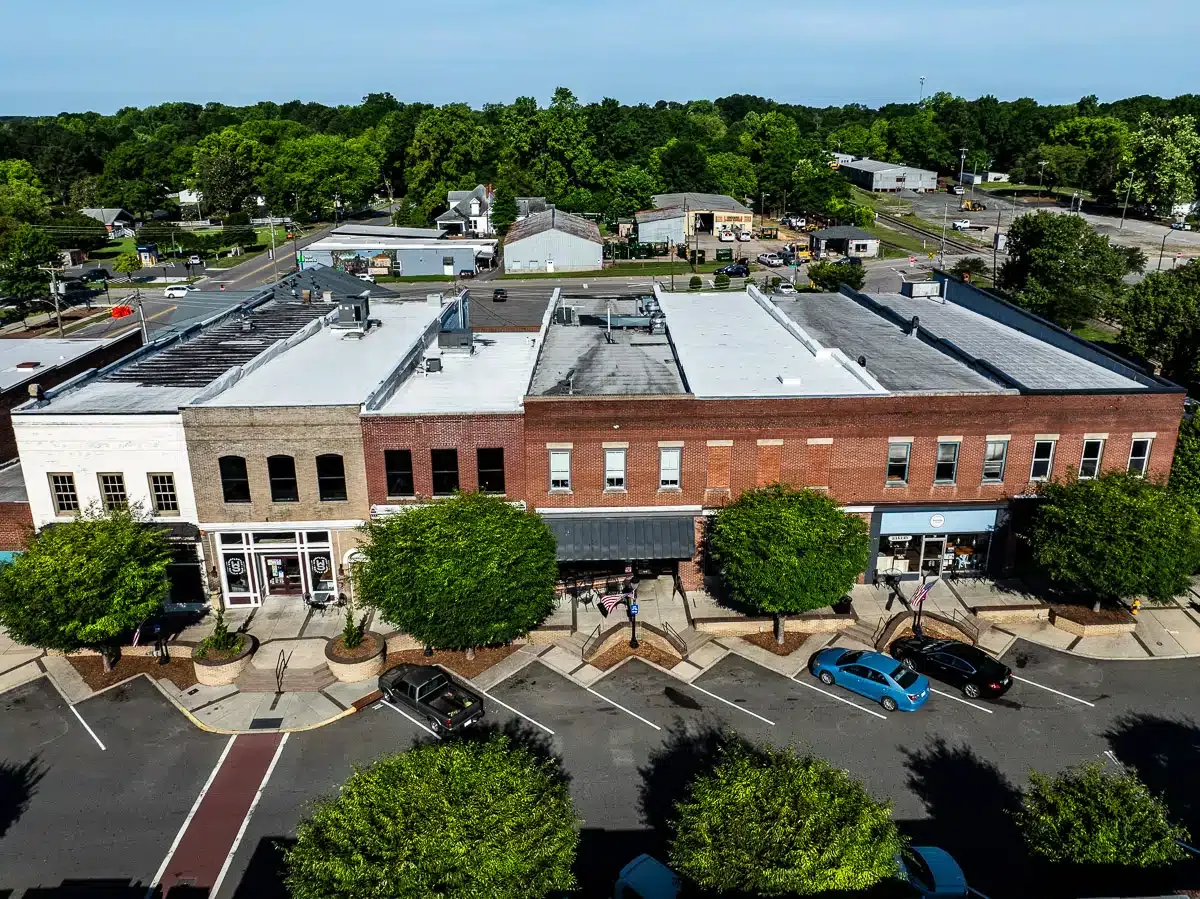
A large open field needs a pattern. We divide the roof into zones on the plan, walk each zone in lines, and look at seams, laps, fasteners, patches, penetrations and standing water. Probes at a sample of seams show whether the lap line is still sealed, and test openings at doubtful spots show the insulation and the substrate condition. We photograph everything that deviates, with enough of the surrounding roof to locate it. On a big roof, one repair can cover very little of the whole, so the plan shows where repairs are, where problems recur and where the roof is still in sound condition. The result is a picture an owner can use to decide between continued repair and a larger project.
Rooftop equipment on industrial buildings is usually sparse compared with offices, but the pieces that exist are large: makeup air units, exhaust fans, smoke vents and skylights. Each is a curb or a flashing assembly, and each gets the same inspection as a unit on an office roof. Skylights and smoke vents in particular have gaskets and seals that age, and a cracked dome or a failed gasket can be the source of a leak that looks like a membrane problem. We photograph each, log its condition and recommend replacement of components that have reached the end of their service life when the roof is next opened.
Wind lifts a low-slope roof from its perimeter and corners first, and a large roof has a long perimeter. If the membrane is mechanically fastened, we check the fasteners and plates along the seams and edges; if it is ballasted, we check ballast distribution and the edge restraint; if it is adhered, we check bond at the corners and the edge. Edge metal is tested for movement. The Raleigh weather service's climatology covers hail, tornado and damaging-wind reports in 31 counties for 1950 through 2005. That record is context, not a claim about this center, and it is a good reason to walk the perimeters after a severe storm and photograph their condition.
A Cary year brings hot summers and steady rain. On a dark industrial membrane, heat ages seams and sealants, and a large catchment sends a lot of water to few drains. We check each drain, strainer and scupper, confirm the overflow sits higher than the primary and discharges clear, and measure any pond that remains after rain. The scope for a ponding area names its cause, whether a sagging deck, a blocked drain or a low spot between outlets, and its fix, whether a drain reset, a tapered insulation and cover board or a slope correction.

Industrial tenants run on shipping schedules. We ask for the delivery windows, the shift changes and the days when the docks are busiest, then plan staging, lift positions and material delivery to stay out of the way. Fall protection is set at the edges, and roof access points, ladders and hatches are noted. Where a tenant's production is sensitive to dust or noise, the plan keeps loud steps away from those hours. Work on one building does not stop the neighboring buildings, so each gets its own schedule. For the nearby flex and light-industrial area, Park Overlook raises related questions on a smaller scale.
Corridors nearby share the airport and research-park traffic, so Weston Parkway buildings face similar delivery timing questions, though their tenants and equipment differ.
The answer comes from the probes and the survey. A roof with isolated defects takes a commercial roof repair with a drawn boundary. A dry, sound roof with widespread wear can take a coating or a recover. A roof with wet insulation in several zones, or a substrate that no longer holds fasteners, points to replacement, and a metal option such as a metal roof retrofit is worth pricing when the structure can carry it. Cost drivers are area, access, penetrations, insulation thickness, and the hours the tenants can give. The owner receives all of this in a written roof condition report, and permit records are kept alongside it, with the applicable local requirements confirmed for each project.
Doors shake the wall, trucks strike canopies and downspouts discharge nearby. Flashing, edge metal and sealant at those points work harder than the field, so they are checked first.
By zones on a plan, walked in lines, with probes at a sample of seams and test openings where needed. Findings are photographed and mapped. The resulting map shows repairs, recurring problems and sound areas.
Not exactly. Roof area is measured on the plan or on site. We use measured area for scope and cost drivers, not building square footage. A measured plan is the basis for any price.
After any severe storm, even without leaks. Lifted edge metal and loose fasteners can stay hidden until later rain. Dated photographs also support a claim.
Usually. Staging stays off the dock doors, the loudest steps shift away from peak hours, and each section is dry before the crew goes home.
Schedule a roof walk with Commercial Roofing Cary. We will record the docks, the field and the perimeter, and send the owner a scoped next step for each building.
Roof leaking now? Call for emergency roof repair.
Or email [email protected].