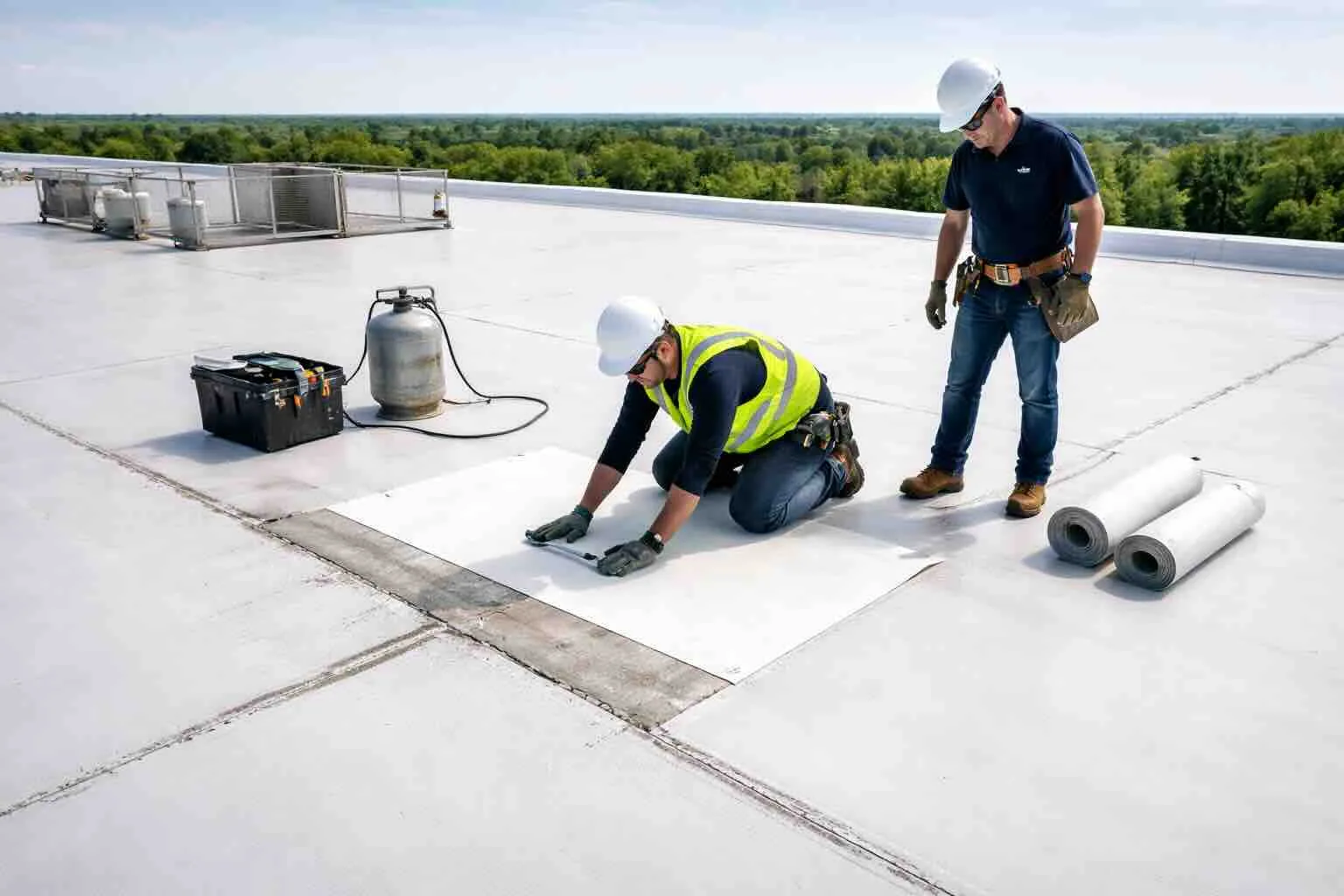
A roof surface cooling at different rates can produce thermal patterns worth testing, but the image alone does not establish moisture. We plan a survey around the roof assembly, recent weather and the decision the owner needs to make, then compare candidate areas with test openings. Cary, NC has offices, retail, hospitality, restaurants and industrial buildings, each with its own layers and service needs. A multi-building industrial group like Woodlake Industrial Center may call for mapped coverage building by building, while a multi-tenant office in Fenton requires the findings be tied to specific work zones. We record what the image suggests and what an opening confirms before recommending removal, repair or a recover review.
Infrared readings depend on surface temperature, sun exposure, wind, cloud cover, recent rain and the roof's thermal mass. We inspect the surface and building conditions before selecting a survey window, then document factors that could affect interpretation. Roof sections with shading, rooftop units or reflective finishes may read differently from open membrane. Cary's NOAA normals show an average July daily maximum of 88.2°F and annual precipitation of 48.80 inches; those averages explain why heat and water movement are relevant considerations, but they cannot validate an individual survey result. We compare thermal images with visible roof conditions, repair records and building layout. If the surface is wet or conditions are unsuitable, we adjust the method or postpone capture instead of presenting an unreliable pattern as a confirmed wet area. We also note interior heating or cooling conditions when they may contribute to a temperature difference. A roof section above conditioned space can respond differently from a canopy, overhang or unconditioned addition. Repairs made shortly before a survey may have different surface characteristics, and standing water can distort the reading. Those factors are entered in the Diligence Notes with capture time and roof-zone reference. If readings remain ambiguous, we do not draw a firm boundary from the thermal image alone. Instead we identify another suitable window or a test opening that can confirm the assembly. This keeps the survey grounded in what was measured while giving the owner a practical route to resolve uncertainty.
We organize the survey by roof zone and label every thermal image so it can be compared with a plan and a visible-light photograph. Candidate patterns are marked for review, with their shape and nearby details recorded. A temperature difference can have several causes, so we select test cuts where the result will answer a useful scope question. At an opening, we inspect the membrane underside, insulation and deck interface, record moisture or deterioration and close the cut with a compatible repair. We do not extrapolate one opening to an entire roof section unless additional checks support that boundary. The manager receives the image, the test location and the observed layer condition together. For wider surface coverage, drone imaging may provide a useful map, while the infrared method targets thermal differences under suitable conditions.
Insulation type, membrane layers, attachment, deck construction and thermal history all affect how a roof responds during a survey. We review those elements before drawing an outline around a suspected wet area. A roof with different additions may require separate interpretation for each assembly. At Park Overlook, Park Overlook pairs completed flex-industrial buildings with a planned project; the site context does not establish the roof materials or moisture condition of any structure. We confirm the building and roof zones being examined rather than relying on development descriptions. If the opening reveals wet insulation, we mark the confirmed boundary and identify whether selective removal can isolate it. A dry test opening can help rule out moisture in a candidate zone, while further testing may be needed if the roof layers vary. At each test cut, we identify the membrane and insulation layers visible at that point and note whether the deck is exposed or remains concealed. If wet material is found, the opening helps establish the removal and repair sequence. We photograph the section before closing it, then record the patch method so a future inspection knows where the assembly was opened. A dry result is also useful, but its reach is limited to the tested location. When the roof plan shows a different addition, slope or prior repair, we may select another opening rather than assuming all adjoining areas match. The manager can review that evidence alongside the image and choose whether the next scope is localized or broader.
Confirmed moisture can affect whether a recover is suitable, where tear-off should extend and how insulation replacement should be phased. We compare openings with the thermal map and repair history, then mark a proposed removal boundary that the owner can review. If conditions are localized, the scope may isolate selected zones and restore adjacent dry material. If moisture or attachment concerns appear broadly, additional openings or a replacement evaluation may be prudent. Our recover review checks layer count, attachment, drainage height and code limits; replacement planning addresses exposed deck and assembly transitions. The report keeps observations, interpretations and recommended work distinct, so a budget decision can reflect the evidence without promising that a thermal image alone predicts the roof's remaining life. Removal depth is set by confirmed conditions and the agreed scope, not by extending a colored image boundary without field checks. We identify if a transition, drain or curb should be rebuilt while surrounding membrane is replaced, and whether roof height will change at the perimeter. If an owner is comparing bids, the survey report makes assumptions visible: test locations, moisture findings, roof layers and the area proposed for removal. A follow-up walk can address any difference between the survey and the proposed removal boundary. That process helps the building team compare two scopes by what each includes, rather than by a square-foot figure disconnected from the test results.
We provide roof-zone maps, thermal and visible images, test-opening locations, layer observations and the repair boundaries discussed with the property manager. The record identifies any areas that could not be surveyed and conditions that may have influenced the readings. If repair proceeds, we can document removal and close-in by zone so future inspections have a reliable comparison. Before capture we coordinate roof entry, identify any mechanical zone requiring attention and settle the survey sections with the manager. A hands-on inspection can add seam, flashing and drainage checks to the survey findings. Arrange an infrared survey with Commercial Roofing Cary to locate candidate areas, confirm selected conditions and prepare the next roof scope from observed layers.
No. It identifies a thermal pattern that may be consistent with retained moisture, but sun, wind, surface material and building conditions can also affect readings. We use selected test openings to confirm the layers.
The roof needs a suitable temperature difference and conditions that support stable readings. Recent rain, cloud cover, wind and surface shading can affect results, so we review the forecast and actual conditions before capturing each zone.
We choose places where an opening can resolve a meaningful question about the assembly or removal boundary. The location is marked on the thermal map and visible photograph, then the layers are recorded and the cut is closed with compatible materials.
The survey can inform that decision when its candidate patterns are checked against the roof assembly and confirmed openings. Layer count, attachment, deck, drainage and code limits also have to be reviewed before a scope is chosen.
We map each section separately and review its surface, thermal response and layer construction. Findings from one assembly are not assumed to apply to another; the report identifies where additional confirmation is needed.
Arrange an infrared survey with Commercial Roofing Cary. We will map candidate zones, select useful test openings and review the confirmed layers before pricing corrective work.
Roof leaking now? Call for emergency roof repair.
Or email [email protected].