The day starts at the drain. A crew member lifts the strainer, watches where the water goes, checks how the membrane turns down into the bowl, and only then looks at the stain a tenant reported two floors below. That order is how Commercial Roofing Cary works on commercial roofs in Cary, NC, and it is the thread through everything the company does: inspect, repair, replace, recover, coat and maintain low-slope and metal roofs, in that order of habit, with the roof read before the remedy is chosen. The people who call are property managers, owners, facility managers and contractors who need a roof they can explain to someone else.
Commercial Roofing Cary repairs and replaces commercial roofs, recovers existing roofs when the assembly allows, restores sound roofs with coatings and maintains roofs on a visit schedule. The company installs and repairs TPO, PVC, EPDM, KEE, modified bitumen, built-up, standing seam and retrofit metal, spray foam, and silicone and acrylic coating systems. It performs hands-on inspections, drone and infrared moisture surveys, written condition reports with photographs, preventive maintenance and insurance claim documentation. It works on occupied buildings and plans around tenants, operations and schedules.
Emergency response runs around the clock. A call at two in the morning gets a person who asks the same questions as a call at two in the afternoon: where is the water, what is below it, is anyone at risk, and what can be done tonight to stop more of it. The first visit dries in the opening and records it, and the permanent plan follows when the roof is dry enough to accept a repair. Repair, replacement and maintenance all follow from the same walk.
A job begins with a conversation about the building: its use, its tenants, its history of leaks and its schedule. A roof walk follows. The crew probes seams, inspects terminations and edge metal returns, traces drains and scuppers, checks penetrations and curbs, photographs each zone and, where a question needs it, opens the assembly at a test location or runs an infrared moisture survey. The findings become a scope with a repair boundary, options and a ranked list of open items.
Work is sequenced to keep the building dry and its occupants undisturbed: protection first, then removal and repair, then tie-ins, flashing and edge metal, then testing. Every section is closed to a watertight edge before the crew leaves. The closeout file holds a numbered roof plan, dated photographs, probe and test results, materials used and what remains open. The next person to touch the roof can start where the last one stopped.
Access and close-in are planned as carefully as the repair itself. Before mobilizing, the crew agrees with the manager on the hatch or ladder, the lift position, the debris route, the tenant notice and the person who can call a pause. Those items go on a single page, and the page goes in the file.
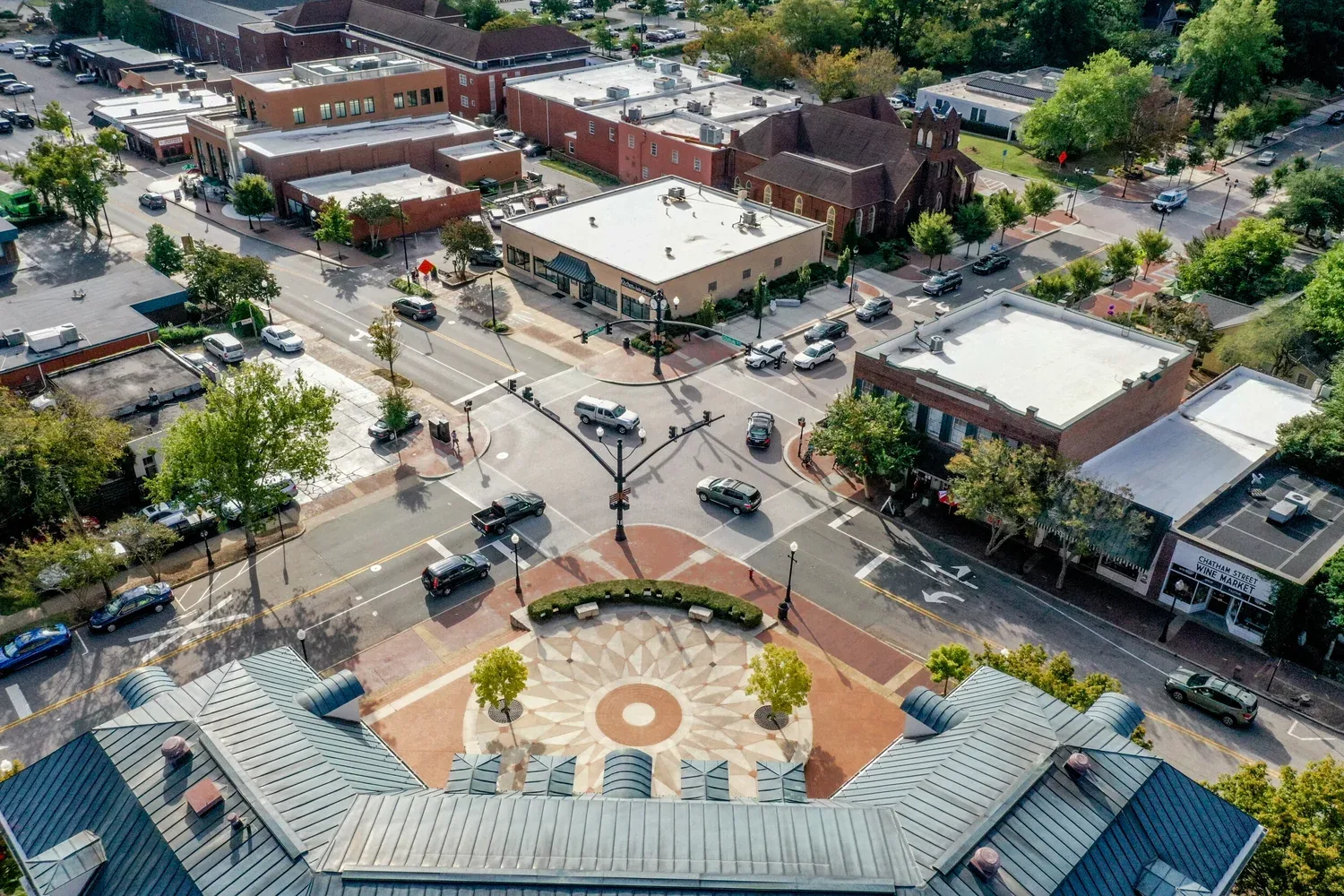
Offices, shops, hotels, restaurants and flex or industrial buildings fill Cary's corporate parks, and the roof work follows that variety. At Fenton, a mixed-use district with offices, shops, dining and residential uses, tenants and customers shape the schedule. At Woodlake Industrial Center, seven industrial buildings near Research Triangle Park and RDU International Airport, deliveries and loading activity shape it. Mixed-use parks like Crescent put retail, hotels, restaurants and offices side by side.
The owners behind those buildings include property managers, investors and REITs, health systems, school districts, public agencies, manufacturers, logistics operators and retail and hospitality groups, and the general contractors who build and renovate for them. The town's economic base, with technology, information and life sciences among its strengths, and Research Triangle Park reporting more than 385 companies, means many of those owners operate equipment-heavy or schedule-sensitive buildings. Each group receives the record in the form it uses, from a ranked table for property owners and managers to a bid-ready scope for public buyers.
A roof outlasts the people who worked on it, and a manager who inherits a building should not have to guess what was done to the roof. Photographs are taken with the surrounding surface in the frame, so a detail can be found again on a later visit. Probe results are logged by location. Temporary work is recorded separately from permanent work, and event damage is kept apart from wear. The same discipline protects the owner in a claim, a sale or a warranty question, because the file can be read by someone who was not there.
The same habit governs what the company will and will not say. It describes what the roof shows, it names the options with their evidence and it leaves coverage decisions to carriers, warranty terms to manufacturers and permit decisions to the local authority. Where a fact is not known, the record says it is not known, and the next step is the test that would find out.
The Cary station's long-term normals describe a mild year with hot summers: a mean annual temperature near 60 degrees, July highs around 88, roughly 33 days at or above 90 and just under 49 inches of precipitation. Summer heat ages seams, sealants and flashing, and the rain loads drains and tests every joint. The Raleigh weather service office's severe-weather record covers 31 counties and speaks to the region, not to any one building. A damage repair starts from what the roof shows, with the event date taken from the carrier's data.
No weather record accounts for ponding on a single roof, so each roof is measured: the low point is found, the path to the outlet is traced and the result is set beside the repair history before anyone proposes a fix.
The state writes its building codes as modifications to the International Codes, adopted through the Building Code Council, and its 2018 family is listed as currently effective. Local requirements apply on top, so the permit path is confirmed for each scope before material is ordered. On military or secured properties, the owner's access, escort and badging rules are built into the schedule, and roofing follows the criteria the owner specifies. Manufacturer systems are described as the manufacturers publish them, and installation follows the product's published details.
Property managers, facility managers, owners and contractors with a leak, a budget question or a closing date. The first step is the same for all: a walk of the roof.
Yes, in sections, with protection below the work and noisy tasks timed to the least sensitive hours.
A numbered plan, photographs by zone, probe results and a ranked list of open items with a scope for each.
Calls are taken at any hour, any day, and the first visit dries in the opening and records it.
No. It documents the roof and the repair, and carriers and manufacturers decide their own terms.
Request a roof assessment or call 555-555-5555.