
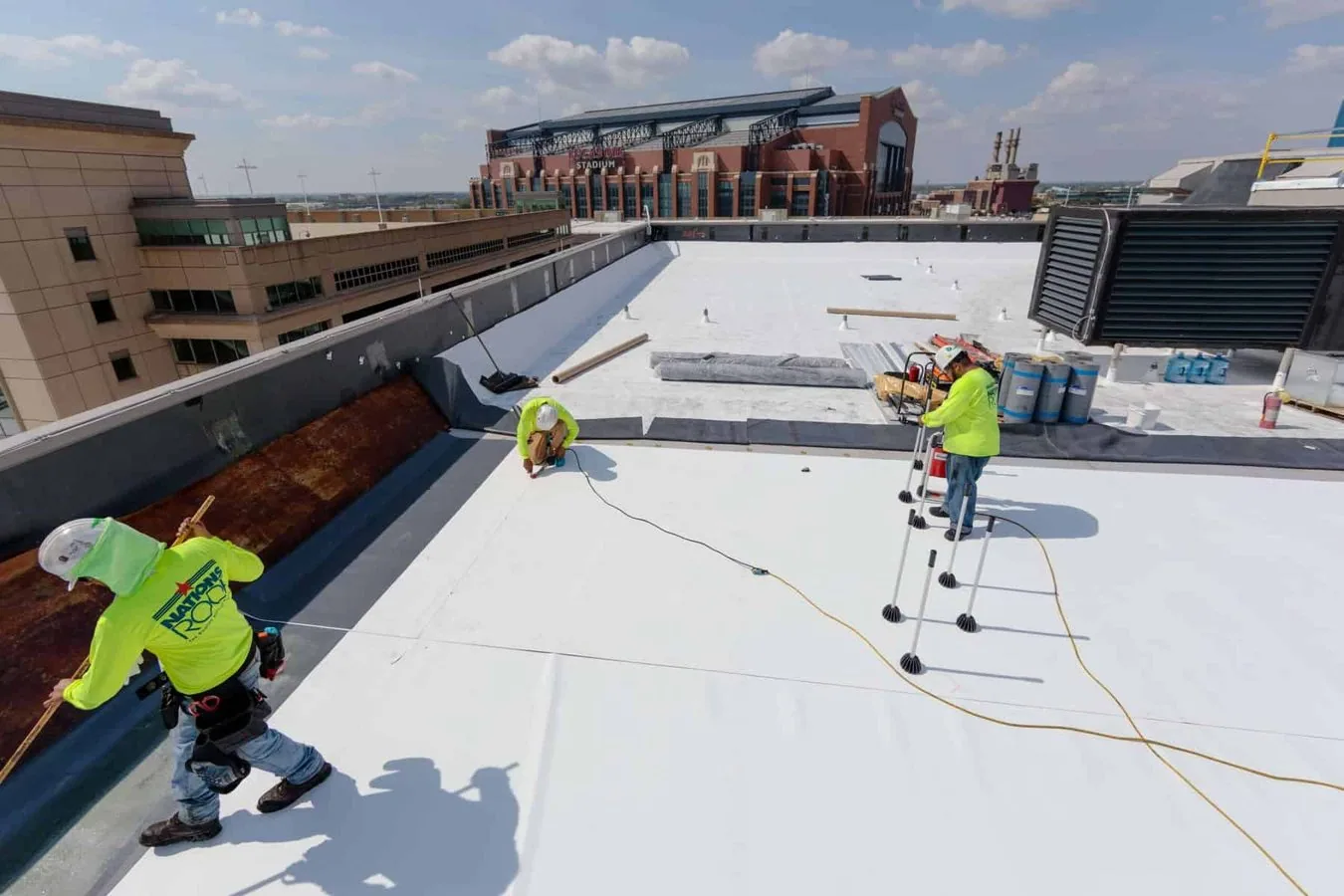
A roof budget line is usually written long before anyone has looked at the lap lines, and the year it lands is the year it is wrong. Capital planning reverses that order. We start with what the roofs show: membrane wear at the field seams, termination edges that have pulled, insulation that tests wet, drains that hold water after rain. Then we ask how long each condition can be managed by repair and what each year of waiting adds to the cost. For owners in Cary, NC, where roofs over offices, shops, hotels and flex buildings age under summer heat and a heavy annual rainfall, the plan puts replacement dates on a calendar the finance team can use.
Remaining life is a range, not a date. We build it from evidence: the system type, the age, the condition of seams and flashings, test openings, probe results and any moisture found in the insulation. A membrane with dry insulation and sound seams may carry a long range; one with repeated repairs at the same details carries a short one.
The range is stated with its assumptions. If the estimate depends on a coating, on a particular drain repair or on the owner keeping a maintenance schedule, the plan says so. Owners can then see which assumptions they control and which they only watch.
Age alone misleads. Two roofs of the same age and system can sit at opposite ends of the range because one drains well and the other holds water, or because one was shaded and the other baked. We weigh age as one input beside seam condition, drainage, repair density and moisture, and we show the weights so the estimate can be challenged.
July afternoons in the station's normals peak around 88.2°F, 32.9 days a year reach 90°F or more, and annual precipitation totals 48.80 inches. Heat ages membranes and sealants, and rainfall tests drains, so both shorten the margin on a roof that is already near the end of its service range.
Planning also needs the calendar. Replacement work is easiest in dry, mild weather, and those windows fill early. A roof that fails in July forces an emergency scope at emergency pricing, while the same roof scheduled a year ahead can be bid, ordered and installed on the owner's terms. Dates in the plan carry that lead time with them. A replacement shown for next spring carries its design, permit and ordering steps on the calendar in front of it.
Storm exposure belongs in the plan as a scenario. Regional storm history is part of the picture: the Raleigh forecast office keeps hail, tornado and wind-damage reports for a 31-county area, which is background and not a forecast for any building. The plan keeps a reserve line for storm repair and lists which roofs would need attention first after an event.
Each roof gets scenarios, not a single answer. The repair-forward scenario keeps a sound field and fixes details. A recover adds a new membrane over a dry assembly. A replacement removes the old layers when the insulation or deck is compromised. A roof coating extends the life of a sound membrane when the substrate allows.
For each scenario the plan lists the conditions that must be true, the work involved, the cost drivers and the likely life after the work. Costs are described by what drives them: area, tear-off depth, insulation thickness, crane access, tenant protection and disposal. We avoid single numbers when the scope is still unsettled.
Some scenarios close off others. A recover cannot follow a roof with wet insulation, a coating cannot follow a failed seam field and a repair-forward plan cannot follow a deck that has started to deflect. The plan states these dependencies, so the owner does not fund a coating that the next test would have ruled out.
Order follows consequence and condition together. A roof over a laboratory, a data room or a kitchen outranks a roof of the same condition over a storage bay. A roof with active moisture outranks a roof that is merely old. The plan ranks sections on both scales and shows the ranking, so a finance team can see why one building moved ahead of another.
Bundling matters. Two adjacent roofs of similar age can share mobilization, crane time and a single permit set, and the plan notes where that saving exists. It also notes where bundling would force a good roof to be replaced early, which is rarely worth it.
Location also shapes sequence. Roofs near Eastern Cary Gateway, with its two I-40 interchanges, and those along Weston Parkway close to NC 54 and RDU International Airport sit on different approaches, so crews and trucks can be routed by area. Roofs in one area can be grouped on a single mobilization when their windows line up.
The state fire marshal's office treats the 2018 North Carolina State Building Code family as the code currently in effect, a state-adopted set of changes to the International Codes written by the Building Code Council. Local requirements and permits still have to be confirmed for each project.
The plan carries those items as budget lines: permit fees, inspection stages, any insulation or fire-rating upgrade the code path triggers and the time a permit takes. We list the questions we expect the reviewer to raise, so the budget is not built on a surprise. When a code answer is still open, the line shows a range.
A plan older than a year is a guess. We update it after each season's walk, after any storm entry and after any repair that changes a section's rating. The update is short: new photos, changed ratings, revised ranges and a note on what moved. The roof asset record supplies the underlying data, and a condition report supplies the written findings.
Owners who hold roofs for sale or refinance often ask for the plan as a one-page summary. We provide it, with the supporting records attached, so a real estate investor can answer a buyer's roof questions with dated evidence.
Finally, the plan records what was decided and why. When an owner defers a replacement, the entry says what condition was accepted, what trigger would move the work forward and when the roof will be rechecked. That note is more useful two years later than any forecast.
As far ahead as the remaining-life range allows, with lead time for design, permit and ordering. The deciding factor is how fast the roof's condition is changing.
Yes when the repairs address real details and the insulation is dry. Repairs that chase wet insulation only postpone the larger bill.
The plan ranks work so the funded items go to the highest-consequence roofs, and the deferred items carry a stated risk and a recheck date.
Not before the scope is measured. We list cost drivers and ranges, and a firm number follows the roof walk and test openings.
It does. Roofs from Weston Parkway to Eastern Cary Gateway can sit on one schedule, each with its own condition and consequence ranking.
Arrange a roof walk with Commercial Roofing Cary. We will record condition, estimate remaining life and return a multi-year plan with scenarios and cost drivers for each roof.
Roof leaking now? Call for emergency roof repair.
Or email [email protected].