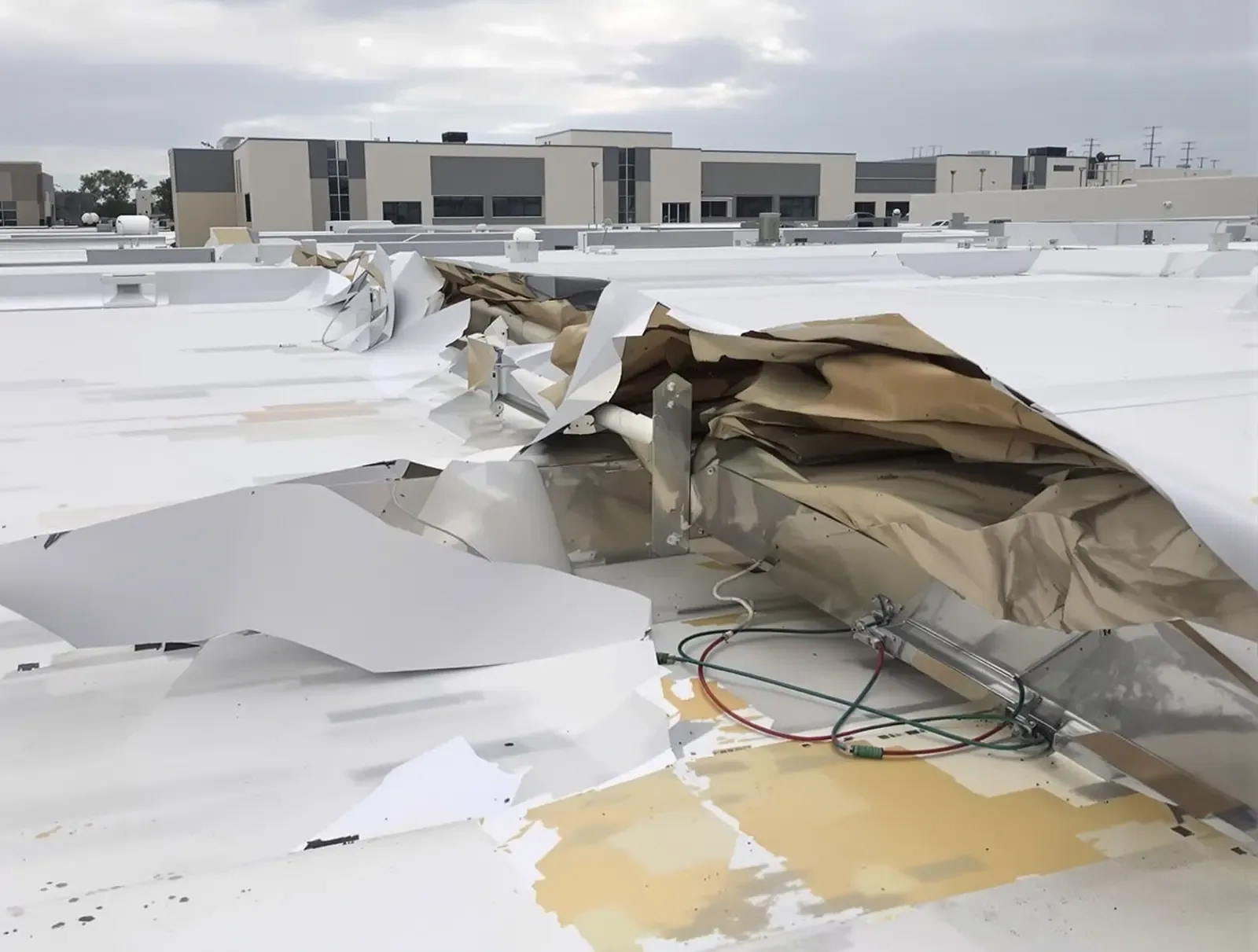
Tornado damage seldom stops at the edge of the membrane, so the first question on a damaged commercial building is not what to patch but whether anyone can safely stand on what remains. Commercial Roofing Cary responds to tornado and severe-wind roof damage on commercial buildings in Cary, NC with the order that large losses require: confirm safety and structural stability, protect the interior from rain, remove what is loose, document what is left and then rebuild in phases. We work with the owner, the adjuster and the structural engineer, and we keep the record of each building separate so that a loss across several properties stays readable.
A building hit by a tornado can have a compromised deck, displaced rooftop equipment, broken utility lines and loose debris overhead. Roof access waits for clearance from the owner, the local authority and, where the damage warrants it, a structural engineer. Our first visit is often at ground level or from a safe adjacent point: photographs of the building from every side, a list of visible openings, and a note of any equipment that has moved. Emergency calls are answered at any hour, and we arrive prepared to place temporary protection as soon as the roof is cleared.
Power, gas and fire-protection systems may be affected, so we coordinate with the building engineer before any work above them. Loose metal, insulation and membrane that could fall are secured or removed from a safe position, and the area below is fenced. Safety comes before speed because a second injury on a damaged roof would add a different kind of loss.
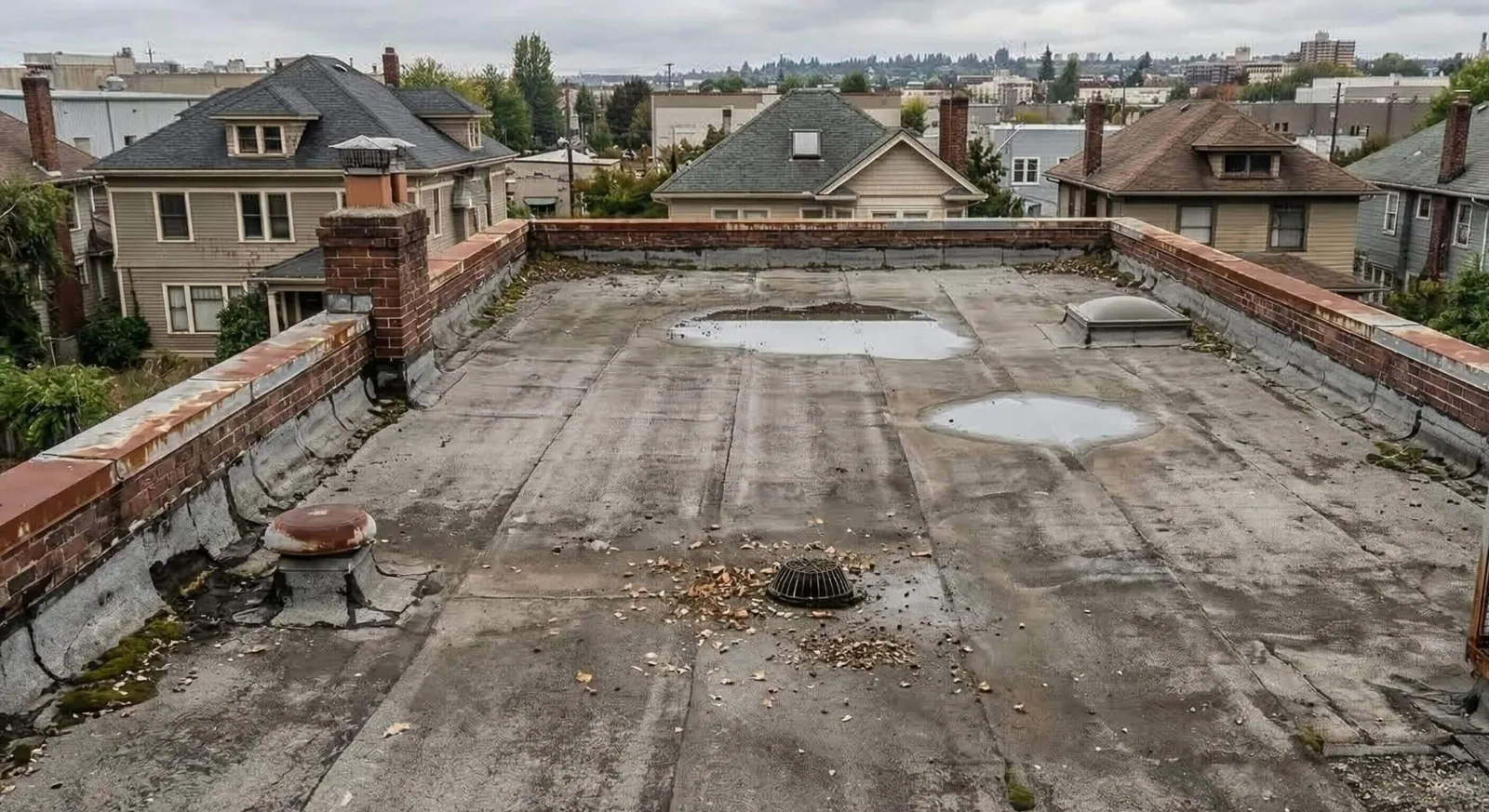
Severe wind can strip edge metal, peel membrane from the perimeter inward, lift insulation boards, tear off rooftop units and curbs, collapse parapets and impale the roof with debris from other structures. The damage can range from a few lifted edges to an open deck or a missing section of roof. We map it by zone: areas with no roof, areas with membrane but no insulation, areas with damaged but attached assembly and areas that look intact but sit beside damage. For each zone we record deck condition, fastener holding and signs of racking or lifted supports.
Debris is documented before it is moved: what it is, where it landed and what it did to the surface. A piece of metal that impaled the membrane is evidence of a puncture, and it is photographed in place. Where debris came from a neighbor's property, the record notes the direction so the owner and adjuster can follow it.
A large opening needs a larger temporary system than a patch. Depending on the damage, we install heavy tarps secured with battens to sound framing, temporary membrane over the deck, plywood decking over a hole or a framed cover. The protection has to resist wind, shed water and not overload damaged framing. We secure the edges so they cannot flutter, route drainage to a safe discharge and photograph the whole installation. In rain, interior protection and extraction are coordinated with the restoration contractor.
Temporary protection can remain in place for weeks while permits, materials and engineering catch up, so we inspect it after each storm and record its condition. A permanent repair after a storm goes through the local permit path, measured against the state building code.
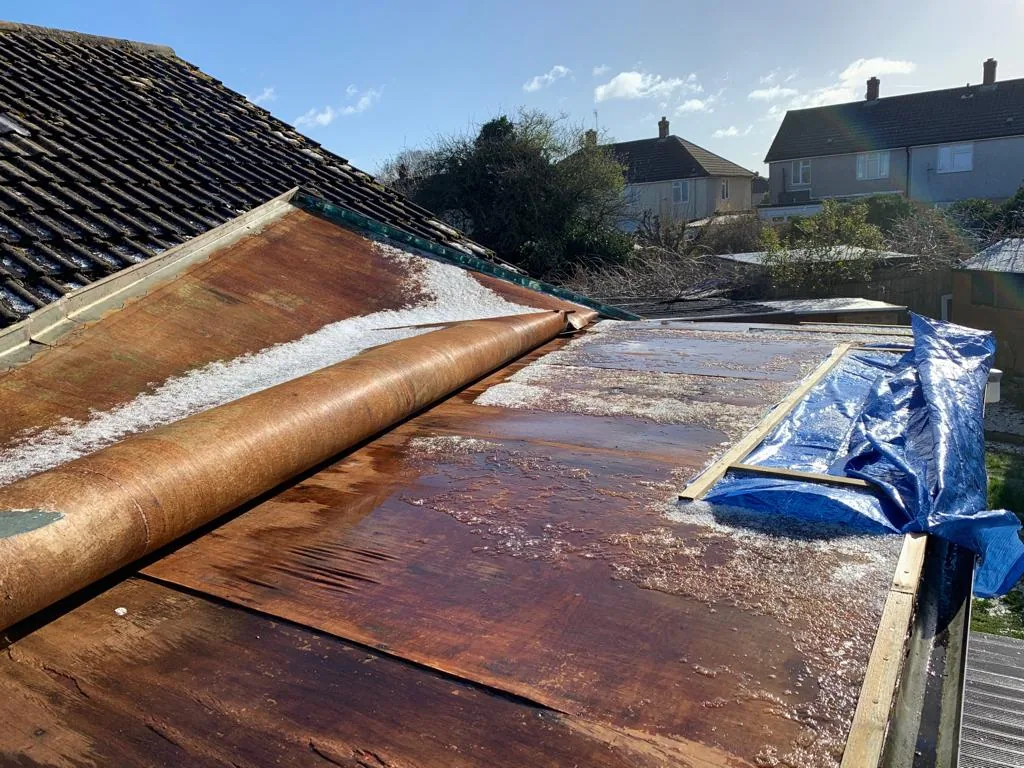
A tornado or severe-wind event can affect several buildings in one area. In multi-building properties such as the seven buildings at Woodlake Industrial Center or the flex-industrial buildings at Park Overlook, we rank the buildings by exposure: which have open decks, which hold sensitive contents, which have tenants waiting to re-enter. The temporary protection goes on in that order, and the permanent repairs follow the same ranking, adjusted for material lead times and crew capacity. Each building has its own file.
The Raleigh weather service's regional record from 1950 to 2005 covers tornadoes, hail and damaging wind, and it is context and not a claim that an event struck any particular building. The practical lesson is to have a baseline record of each roof before a storm, which makes comparison after one much faster. A commercial roof inspection file kept current is that baseline.
Once the structure is cleared, the rebuild follows the order of the roof: repair or replace the deck, install insulation, set new curbs and supports, install membrane and flashing, set edge metal, and test. Where the existing roof beyond the damage is sound, the new work is tied into it with the correct tie-in width and compatible materials. Where it is not, the scope grows. We present a section replacement, a recover where the assembly allows and a full replacement with the same assumptions, and the owner decides with the evidence in hand. Because climate matters to the work window, installation is planned for dry weather and suitable temperatures.
Re-entry depends on the roof being watertight and the structure being cleared, and those are two separate sign-offs. We tell the owner when the dry-in is complete and what has been left open, so the restoration contractor and the tenants know what to expect. In a multi-tenant building, we map which suites sit under temporary protection, which sit under permanent repair and which were never affected, because each category has its own timeline and its own risk if rain returns. A suite under a temporary cover is not the same as a suite under a finished roof, and the map says so.
For businesses that must reopen quickly, we phase the permanent work so the sections over their space finish first, and we schedule noisy work for hours that do not conflict with reopening. The sequence is written down and shared, with the date each area is expected to be complete and the weather conditions the date depends on. When rain delays a section, the revised date is reported the same day, with an emergency roof repair response available for any new leak.
The record has the building-by-building plan, ground-level and roof photographs, structural findings, debris documentation, temporary and permanent work with dates and open items. It follows the format used in wind damage and hail damage work, so an adjuster who has seen one can read the other. Invoices tie to the same numbered zones, and the file is organized for the carrier, the lender and the owner's records.
Safety clearance sets the time. Once the roof is cleared, temporary protection goes on right away, and emergency calls are taken at any hour.
Where the damage affects framing, supports or large areas of deck, yes. We supply photographs and measurements for the review.
We photograph it in place first, then remove it with the owner's and adjuster's agreement. Notes record its type and direction.
Yes, in ranked order, with a separate file for each. Crews and materials are shared across the group to speed up protection.
Its life depends on upkeep. After each storm we walk it, and any worn section is swapped out until the permanent work begins.
Contact Commercial Roofing Cary at any hour. We will review the observed damage once the roof is cleared, place temporary protection and return a scoped next step for each building.
Roof leaking now? Call for emergency roof repair.
Or email [email protected].